

 LIMITED TIME OFFER!
 FREE Shipping

Why Envi Electric Wall Panel Heaters Are the Perfect Heaters For Tiny Homes
5th Jun 2026
Tiny home living is a study in tradeoffs. Every square inch has to justify itself, every appliance has to pull its weight, and every decision about systems, mechanical, electrical, and structural, gets magnified by the constraints of a sub-400-square-foot footprint. Nowhere is this more obvious than in the question of heat.
Tiny home dwellers know the frustration well. The bulky portable space heater that eats half the floor in the loft. The propane setup that keeps you up at night worrying about carbon monoxide. The mini-split that costs more than the cabinetry. The baseboard heaters that nobody can seem to install correctly in a 24-foot trailer. Heating a tiny home shouldn't be this complicated, and increasingly, it isn't, because a small but growing number of tiny home owners and builders are discovering the Envi electric wall panel heater.
If you've been searching for a heating solution that's slim, silent, safe, energy-efficient, and purpose-built for small spaces, the Envi heater deserves a serious look. This article breaks down exactly why our wall-mounted convection panels have become a favorite among the tiny home community, what makes them mechanically and electrically distinct from the typical big-box space heater, and how to think about sizing, placement, and integration into your tiny home build.
The Unique Heating Challenges of Tiny Home Living
Before getting into why the Envi works so well, it's worth understanding what makes tiny home heating fundamentally different from heating a conventional house, an apartment, or even a single room in a larger home.
Space is the first and most obvious constraint. A typical tiny home ranges from roughly 100 to 400 square feet, with most of that volume already committed to sleeping, cooking, bathing, and storage. There is no mechanical room, no basement, no closet large enough to house a furnace. Every inch of floor space lost to a freestanding heater is an inch lost to living. This is why wall-mounted solutions are almost always preferred over portable ones in tiny home contexts.
Power budget is the second. Tiny homes, especially tiny homes on wheels (THOWs), often run on 30-amp or 50-amp shore power. Some are off-grid with solar arrays and battery banks. Even on-grid stationary tiny homes typically have modest electrical service compared to traditional homes. A conventional 1,500-watt space heater pulling 12.5 amps can dominate the available power budget, leaving little headroom for the microwave, water heater, or anything else running simultaneously. Heating systems that draw less power and play nicely with limited electrical service are enormously valuable.
Safety stakes are higher in a smaller volume. A tiny home concentrates people, combustible materials, and electrical loads into a very small space. Open-flame heaters, hot-surface heaters, and forced-air heaters with exposed coils all carry risk that scales unfavorably with reduced square footage. Carbon monoxide from improperly vented propane is a well-documented hazard in tiny homes due to limited ventilation. Tip-over risks for portable heaters are amplified in trailer-mounted homes that experience movement.
Air quality matters more, not less, in compact spaces. With reduced air volume, anything a heater introduces into the air, whether dust, allergens, dryness, or combustion byproducts, accumulates faster and reaches occupants more directly. This is why tiny home dwellers often complain about winter dryness, dust circulation from forced-air systems, and respiratory irritation from older heating setups.
Heat distribution is tricky. Tiny homes often have lofts, half-walls, sleeping nooks, and isolated bathroom or closet zones. Air doesn't move uniformly through these layouts. A single high-output heat source can leave loft sleepers roasting while floor-level living areas stay cold, or vice versa. Zoned heating, with multiple smaller units in distinct areas, often works better than one big unit.
These five constraints, space, power, safety, air quality, and zoning, define the brief for any tiny home heating solution. The Envi wall panel heater addresses all five with a degree of intentionality that few other products can match.
What Is an Envi Heater?
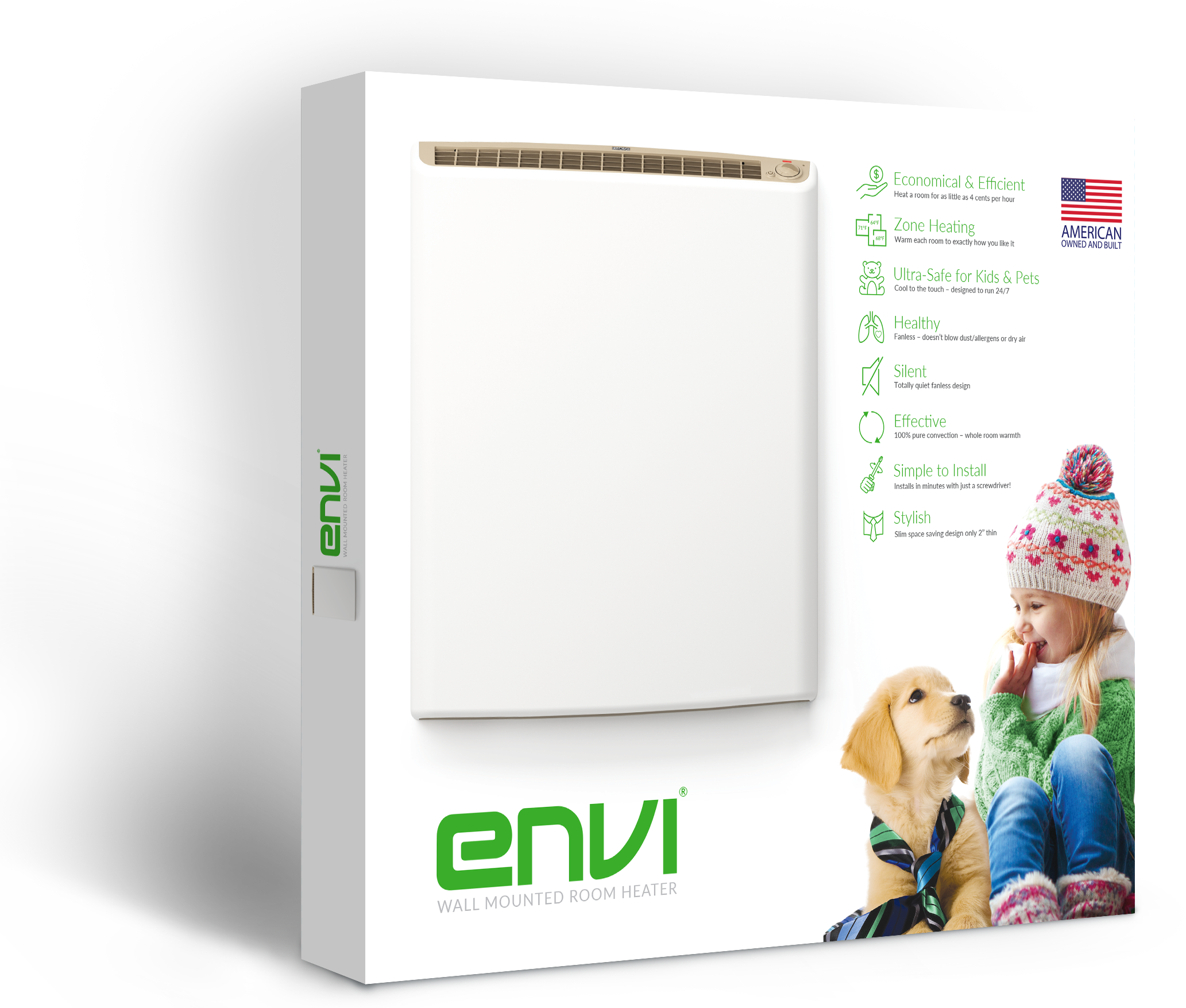
The Envi is a wall-mounted electric convection panel heater that has been refining this product line for over a decade. The current generation of Envi heaters comes in several configurations, including the standard 500-watt LE5012P (3rd generation), the EnviMAX line at 1,000 watts for larger spaces, and the newer Smart Envi models that add Wi-Fi connectivity, digital thermostat controls, and smart home integration with Amazon Alexa and Google Home.
What sets the Envi apart from a typical electric heater is its patented Stack Convection design. Rather than using a fan to force air across a heating element, the Envi uses simulated internal "stacks" of varying heights to drive natural convection through the unit. Cold air enters the bottom, gets heated as it rises through the chambers, and exits the top vent as warm, gently-moving air. There are no moving parts, no fan, and no forced airflow.
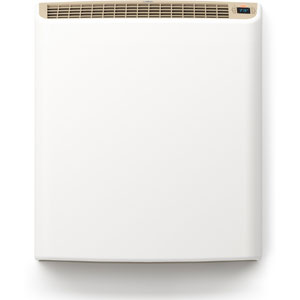
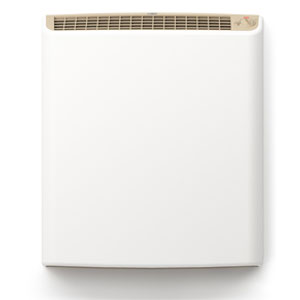
The unit itself is remarkably slim, only about 2 inches deep on the standard models, with a clean, modern white panel face that mounts flush to the wall. Installation requires no contractor and no drilling into the wall in most cases; the heater hangs on a small wall-mounted bracket and plugs into a standard 120V outlet (the plug-in versions) or wires directly into the electrical system (the hardwired versions, which are UL-listed for permanent installation).
That's the basic product. Now let's get into why it's such a strong fit for tiny homes specifically.
Why the Envi Heater Works So Well in Tiny Homes
A Two-Inch Depth That Reclaims Your Floor Space
The single biggest practical reason the Envi suits tiny homes is its physical footprint, or near-total lack thereof. At roughly 2 inches deep, the heater barely projects from the wall. Compare this to a freestanding oil-filled radiator (typically 10 to 14 inches deep, plus clearance), a tower ceramic heater (8 to 12 inches deep), or even a baseboard heater (which protrudes 3 to 4 inches and runs the full length of a wall at floor level, blocking furniture placement).
In a tiny home where every cubic foot is contested, getting heat off the floor entirely changes what's possible. The space under a wall-mounted Envi can hold a small bookshelf, a cat bed, a yoga mat, or simply remain open to make the room feel larger. Furniture can be placed against walls without worrying about heater clearance. Bathrooms, often the trickiest tiny home zone for heating, can finally get a dedicated heat source without sacrificing the small amount of floor space they have.
Low Wattage That Respects Your Electrical Service
The standard 500-watt Envi draws roughly 4.2 amps at 120V. The 1,000-watt EnviMAX draws about 8.3 amps. For perspective, a conventional 1,500-watt portable heater pulls 12.5 amps and can dominate a single 15-amp circuit by itself.
For tiny homes on 30-amp shore power, this difference is enormous. A 500-watt Envi leaves room on the circuit for lights, a laptop, a coffee maker, and other small loads without tripping breakers. For homes with 50-amp service, you can run multiple Envi units in different zones simultaneously, something that would be impossible with traditional space heaters.
Genuinely Silent Operation for Better Sleep
Tiny homes magnify sound. With sleeping areas often within feet of the main living space, and lofts that put sleepers directly above where heaters typically run, fan noise becomes a serious quality-of-life issue. Anyone who has tried to sleep through the cycling whoosh of a forced-air space heater knows the problem.
The Envi's fanless design produces zero mechanical noise. There is no fan, no compressor, no clicking thermostat (on the analog models), nothing. The Stack Convection technology moves air through pure thermal action. The only thing you hear is whatever ambient sound was in the room before you turned it on.
Beyond noise, the Envi includes a small but thoughtful detail: an auto-dimming power indicator light that fades in dark rooms. For loft sleepers staring up at a heater mounted on the bedroom wall, this matters. No glowing LED to disrupt sleep. This kind of design intent toward the lived experience of small-space residents is rare in heating products.
Cool-to-the-Touch Surface Temperature
A standard Envi heater's exterior surface stays at roughly 90°F during operation. This is genuinely cool to the touch, the temperature of a warm summer day, not the searing 200°F-plus surface temperatures of ceramic and quartz heaters that can ignite curtains, melt plastic, or burn skin on contact.
In a tiny home, where curtains, bedding, clothing, and combustible materials are often within a foot or two of any wall surface, this safety margin is transformative. You can place a couch directly against a wall with an Envi mounted on it. You can hang a curtain near it. Children, pets, and tired humans bumping into the wall in the middle of the night will not get burned. Pets that like to sleep near warmth can curl up beside it without risk.
The Envi also includes Wall-Sens technology, a sensor that automatically cuts power if the unit is removed from its wall bracket. Combined with automatic thermal cutoff and the cool-touch surface, this creates a heater you can genuinely run 24/7 in an occupied tiny home without anxiety, which is exactly the use case most tiny homes need.
Installation Without Drills, Contractors, or Compromise
The plug-in Envi models install in roughly ten minutes with nothing more than a screwdriver. The mounting bracket attaches to the wall with a few small screws, the heater hangs onto the bracket, and the cord plugs into a standard outlet. Cord storage is built into the heater body for a clean look. Renters and lease-to-own tiny home owners can install it without modifying the structure significantly. DIY tiny home builders can integrate it without coordinating with an electrician, assuming they have an outlet on the wall in question.
Zone Heating That Matches Tiny Home Layouts
Tiny homes are awkward to heat with a single source because of their compartmentalized layouts: the loft sleeps differently than the floor lives, the bathroom needs heat at different times than the kitchen, and a closed bedroom door cuts off airflow entirely. Multiple small Envi units in different zones, each with its own thermostat, can match heat to use much better than one central heater can.
A common configuration: a 500-watt Envi in the main living area, a 500-watt unit in the bathroom (the Envi makes an excellent bathroom heater), and either a small 500-watt unit or no dedicated heater in the loft (which often gets sufficient rising heat from below). Each zone can be controlled independently. With Smart Envi models, all zones can be controlled from a smartphone app, scheduled around occupancy patterns, or grouped and managed via Alexa or Google Home voice commands.
This zone strategy is also where the Envi pulls ahead of mini-split systems for some tiny homes. Mini-splits are excellent but expensive, require professional installation, need an external condenser unit (problematic for THOWs that move), and typically heat the entire interior volume from a single point. Multiple Envis can match heat distribution to the actual lived geometry of the home.
Sizing an Envi for Your Tiny Home
Envi heater sizing is straightforward, but worth getting right. The 500-watt models (LE5012P plug-in, LE5012D and LE5022D hardwired, and the Smart Envi SE5012P and SE5022D) are rated to heat rooms up to roughly 150 square feet. The 1,000-watt EnviMAX models (EM1012P plug-in, EM1012D and EM1022D hardwired, and the Smart Envi MAX SM1012P) are rated for spaces up to roughly 350 square feet.
For most tiny homes, this maps cleanly to one of three configurations:
Single-unit setups work well for very small, well-insulated tiny homes (under 200 sq ft) in mild climates. A single EnviMAX 1,000-watt unit mounted in the main living area can carry the entire heating load if the floor plan is open and the home is well-sealed.
Two-unit setups are common for typical 200 to 350 sq ft tiny homes. One EnviMAX (1,000W) in the main living area plus a 500W standard Envi in the bathroom or bedroom zone gives you primary heat plus targeted comfort heat where you need it most.
Three-unit setups are typical for larger tiny homes (350-400 sq ft) or homes in colder climates. Add a third unit in the loft or bedroom for full coverage. Total connected load is still well under 2,500 watts, which is manageable on most tiny home electrical systems.
Smart Envi Features for Tiny Home Living
The newer Smart Envi line, launched in the most recent generation, adds capabilities that pair particularly well with tiny home use cases:
Smartphone app control lets you adjust temperature, set schedules, and turn units on or off remotely. For tiny home dwellers who spend time away (digital nomads, traveling workers, weekend tiny-home users), this means you can pre-warm the home before arriving without leaving heat running while away.
Alexa and Google Home integration lets you control heaters by voice. In a tiny home where you're often within arm's reach of the heater anyway, this is less about convenience and more about creating routines, "Alexa, goodnight" can drop bedroom temperature while keeping the bathroom warm for an early morning.
Multi-unit grouping in the app means you can set all your zones at once or manage them individually. For multi-zone tiny home setups, this is genuinely useful.
Scheduling and geofencing allow heaters to anticipate your routines: warm up before you wake, scale back during work hours, return to comfort temperature before you arrive home.
Freeze protection mode is particularly valuable for tiny homes that experience occasional vacancy in winter (vacation rentals, seasonal use, traveling owners). The heater maintains a minimum temperature to prevent pipe freezing without consuming significant energy.
For tiny home owners who already have a smart home setup or want one, the Smart Envi integrates cleanly. For those who prefer simpler controls, the standard 3rd Generation Envi with its built-in analog thermostat works perfectly well and costs less.
Putting It All Together: Why the Envi Earns Its Place
The Envi electric wall panel heater isn't trying to be everything to everyone. It's a focused, well-engineered product that solves a specific problem: how to deliver safe, quiet, efficient heat in a small space without consuming floor area, electrical capacity, or attention.
If you're designing a new tiny home, retrofitting an existing one, or just trying to fix the heating problem in the home you already live in, the Envi deserves a place near the top of your shortlist. Whether you go with the simple 500-watt LE5012P for a small zone, the powerful 1,000-watt EnviMAX for a primary heat source, or the Smart Envi for full app and voice control, you're getting a heater that was effectively designed for the constraints of tiny home living, even if that wasn't the original intent.
In a market full of heaters that try to do too much and end up doing little well, the Envi does one thing exceptionally: it heats small spaces the way small spaces deserve to be heated. For the tiny home community, that's everything.